 Imagine Neville
A private imagined scene does not establish another person’s agreement. Our exercises focus on your participation and keep the other person free to choose. If an action requires their consent, imagination cannot supply it on their behalf.
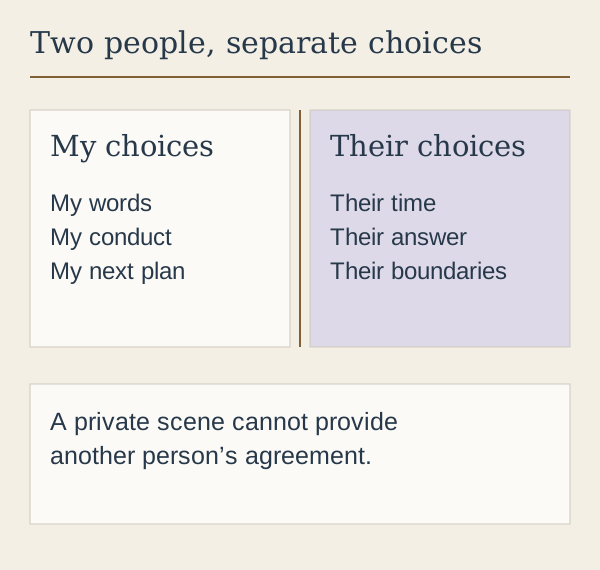
State the boundary of this companion
Neville’s account of assumption in The Power of Awareness makes strong claims about inward states and outward events. Read chapters 2–3.
The practical boundary here is our editorial choice: no claim in a text gives this site evidence that a particular person has agreed to contact, intimacy, a relationship or any other request. We do not rewrite the historical doctrine into modern consent guidance; we state how our own tools may responsibly be used.
Private hope and real permission are different
You may hope for reconciliation or imagine a conversation. Those experiences tell you about your wishes. They do not tell you what another person currently wants.
Look at the action you are considering. Does it involve contact someone has asked you to stop? Does it assume permission never given? Does it turn an ambiguous signal into certainty? If so, changing the inward story does not resolve the practical issue.
This distinction also matters outside romance. A friend’s time, a colleague’s agreement and a family member’s willingness to discuss a subject are not decisions you can make privately for them.
A consent source, with its scope kept clear
RAINN’s Consent 101 concerns sexual consent. It emphasizes clear, voluntary and ongoing communication, rather than pressure or assumption. This page takes the general ethical lesson that agreement belongs to the people involved; it does not offer a legal definition for every jurisdiction or equate every social interaction with sexual consent.
For an actual intimate situation, use appropriate, specific consent guidance. A spiritual exercise is not a replacement for communication, and a previously given yes does not establish agreement to a different act.
Use a decision card before acting
- What action am I considering? Name it plainly, rather than hiding it inside “manifesting.”
- What agreement would this action require? Identify who gets to decide.
- What has actually been communicated? Separate a clear answer from a hope, a dream or a guessed signal.
- What does the answer require of me? Respect a refusal or request to stop. Do not treat silence as evidence of a hidden yes.
- What can I choose independently? Prepare my words, ask appropriately where contact is welcome, accept the response or make another plan.
The card is our practical aid. It is not a claim that private reflection can read someone’s mind.
Edit two scenes so they concern your conduct
Draft: “They realize they were wrong and return exactly when I want.”
Own-participation version: “I can respond clearly if a mutually welcome conversation happens. If it does not, I make a plan that does not depend on their return.”
Draft: “My colleague agrees to every part of my proposal.”
Own-participation version: “I explain the proposal, ask which part does not work and leave room for a no.”
These edits are original examples. They do not guarantee a conversation or agreement. The scene-editing workshop can help make the chosen version shorter and more concrete.
Record a refusal accurately
Write the communicated answer in the observation field. Put disappointment, hope or uncertainty in the interpretation field. A practical next action may be to stop contact, accept the boundary or turn to another plan. It does not have to be another attempt to change the person’s mind.
The declined-invitation example in the revision notebook shows that separation. The broader evidence guide explains why an inner experience cannot by itself establish an external fact.
Respecting someone’s choice is compatible with having feelings about it. You do not need to erase disappointment or claim that the refusal was secretly what you wanted.
Sources & reading notes
Sources consulted November 5, 2026. Original commentary; short paraphrases with attribution. No complete works are reproduced here.
- Neville Goddard, The Power of Awareness. Chapters 1–3, 6, 21 and 23–24. Third-party book transcription; distinguish it from the 1953 lecture of the same name.
- RAINN, Consent 101: Respect, Boundaries, & Building Trust. Primary educational guidance about sexual consent. This guide draws a clearly identified general ethical analogy; it does not give a jurisdiction-specific legal definition.