 Imagine Neville
There is no single definition that covers every “law of attraction” author. A more useful comparison names the texts. Here we compare Neville Goddard’s The Power of Awareness with William Walker Atkinson’s Dynamic Thought, without presenting either account as established science.
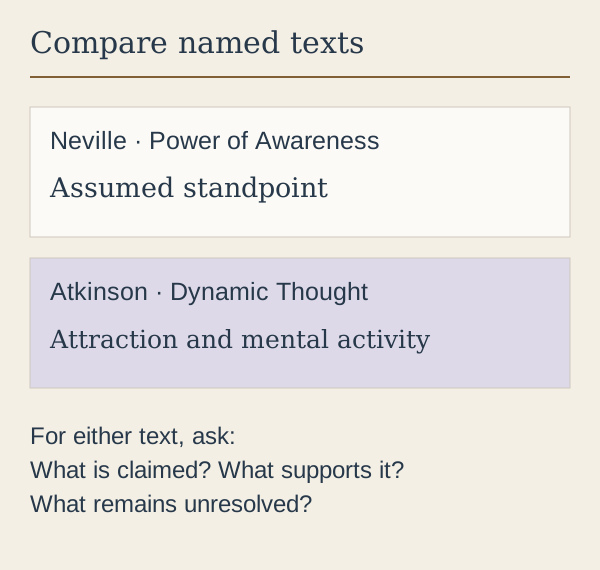
Define the comparison
Neville’s book foregrounds consciousness and the assumed state, especially in chapters 2–3. Atkinson’s Dynamic Thought, chapters X and XVI, connects attraction with a theory of mental activity and influence, extending his account across nature and human life. Read Neville’s chapters 2–3; read Atkinson’s chapters X and XVI.
This is a comparison of those texts, not an account of everything sold under either label today. Atkinson’s Dynamic Thought is also not interchangeable with his separate book Thought Vibration.
A side-by-side reading grid
| Question | Neville text | Atkinson text |
|---|---|---|
| Where to begin? | The assumed standpoint and account of consciousness. | The proposed relation between mental activity, attraction and nature. |
| What language needs checking? | State, consciousness, assumption. | Energy, attraction, mental influence. |
| What should the reader ask? | How is inward acceptance connected to an external fact? | What warrants extending physical analogies to thought and influence? |
| What would not be enough? | A vivid scene followed by a desired event. | A scientific-sounding term or a striking coincidence. |
The questions are our critical apparatus. They do not reduce either author to a slogan or declare all modern followers identical.
Do not let a familiar scientific word settle the issue
A word such as energy can name a physical quantity in one setting and serve a metaphysical explanation in another. The presence of the word does not establish that the second claim has inherited the evidence of the first. Ask what is being measured, how a proposed relationship is tested and which alternatives were ruled out.
Likewise, “law” in a spiritual book’s title is not a certificate that the claim has the status of a well-tested scientific law. Naming the kind of account is a first step toward evaluating it, rather than an insult to someone who finds it meaningful.
One everyday situation, several possible explanations
Suppose a person imagines a welcoming introduction before attending a club meeting. They also arrive early, read the event description and prepare a question. Someone starts a friendly conversation.
Before choosing a metaphysical explanation, list ordinary possibilities: the person appeared approachable, the event encouraged introductions, the prepared question helped, or the other attendee was friendly anyway. You cannot isolate a cause just by selecting the account whose vocabulary you prefer.
Our tools let you record the imagined moment and the later observation separately. The scene-editing workshop turns the example into a concrete personal exercise without prescribing the other attendee’s response.
Why “which one works better?” is incomplete
Specify the outcome first. Do you mean an exercise felt pleasant, that you completed a task, or that your thoughts directly caused an event? A comparison needs a stable definition of success, not a different standard whenever a result is inconvenient.
Neither a survey of slogans nor a collection of selected stories can resolve every causal claim. Our evidence guide explains the narrower distinction between a personal report and a controlled comparison. It does not pretend to be a trial of both authors.
A comparison card to complete while reading
- Name the author, work and chapter.
- Paraphrase one actual claim.
- Identify an example or reason offered for it.
- Write one alternative explanation.
- State what remains unresolved.
Repeat with the second text. If your two cards contain no source locations, return to the books before deciding that you have compared their arguments.
Whichever vocabulary you explore, keep other people’s consent separate from your preferred outcome. A theory of mind does not give this site a basis to promise control over another person.
Sources & reading notes
Sources consulted November 5, 2026. Original commentary; short paraphrases with attribution. No complete works are reproduced here.
- Neville Goddard, The Power of Awareness. Chapters 1–3, 6, 21 and 23–24. Third-party book transcription; distinguish it from the 1953 lecture of the same name.
- William Walker Atkinson, Dynamic Thought; or, The Law of Vibrant Energy. Primary text in Project Gutenberg. Chapters X, “The Law of Attraction,” and XVI, “Thought in Action.” Historical metaphysical claims are not modern physics evidence.