 Imagine Neville
The Power of Awareness names both a book and a lecture. Identify the format before comparing passages. Then distinguish the premise, the argument and the examples offered in support; a shared title does not make two passages interchangeable.
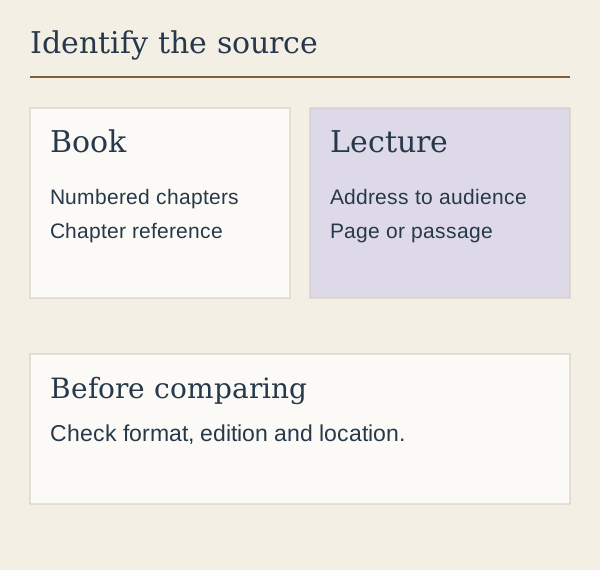
Identify the source before the quotation
The book transcription has 27 numbered chapters; the lecture transcript consulted here is headed 1953 and begins as an address to an audience. The lecture links consciousness, God and imagination near its opening. Open the book; open the lecture transcript.
Do not use the lecture’s first page as if it were the book’s chapter 1. Record “book, chapter” or “lecture, opening/pages” in your note. The source’s own date label is useful metadata; it is not a reason to invent a precise venue or day that you have not verified.
A source-identification checklist
- Does the document have numbered chapters or an opening address?
- Is the title page part of the source or a later website heading?
- Which edition or transcription are you reading?
- Does a modern introduction belong to Neville or to an editor?
- Can you find the claimed sentence in the surrounding paragraph?
When two transcriptions disagree, keep both locations in your note and leave the wording uncertain until you can compare a traceable edition or recording. Search-result snippets are useful for finding a document, but they are not a substitute for reading it.
Trace an argument through the book
Use this original route as a reading exercise: begin with chapters 1–3, then compare chapter 6 with chapter 23. Write down the initial premise, the role assigned to attention and the status of the examples.
Keep those categories visible. A premise tells you what the argument assumes. A proposed mechanism tells you how the author says something happens. An anecdote gives you an account to inspect. One category cannot silently do the work of another.
For terminology, keep the contextual glossary nearby. For a comparison with a different author’s explanatory language, read Neville and Atkinson side by side.
A worked argument sheet
Premise to identify: What does this text treat as fundamental?
Inference to inspect: How does it move from that premise to a claim about events?
Example to evaluate: What happened, according to the account, and what else might explain it?
Open question: What observation could distinguish the proposed explanation from an alternative?
For an original everyday example, imagine someone rehearsing a talk and receiving positive feedback. Their rehearsal, preparation, audience and the feedback itself are different parts of the record. A favorable outcome cannot tell you, by itself, which explanation produced it.
Read the failure chapter as carefully as the success accounts
Chapter 24 discusses failed attempts through the teaching’s account of naturalness. Read chapter 24.
Ask what would count against the explanation. If success is always confirmation and failure is always attributed to an invisible shortcoming, the explanation becomes hard to test. You can describe that structure without attributing bad motives to the author or readers.
In your own notes, avoid diagnosing someone else’s inner state from their circumstances. A difficult outcome is not enough to establish that a person failed inwardly. The critical guide develops this evidence question.
Finish with a reference someone else can follow
Before keeping a quotation or sharing a paraphrase, add the format, chapter or page, source URL and your own interpretation. A useful note might say: “Book, chapter 6; question about attention; compare with the initial premise.” It need not claim the argument has been settled.
If you continue to the later theological vocabulary, the Promise reading guide keeps a reported spiritual experience separate from an ordinary outcome claim. The reading route places both kinds of inquiry in a broader sequence.
Sources & reading notes
Sources consulted November 5, 2026. Original commentary; short paraphrases with attribution. No complete works are reproduced here.
- Neville Goddard, The Power of Awareness. Chapters 1–3, 6, 21 and 23–24. Third-party book transcription; distinguish it from the 1953 lecture of the same name.
- Neville Goddard, The Power of Awareness (lecture, 1953). Lecture transcript, opening pages. This is not the book with the same title.